Research
A multidisciplinary approach to treating intractable brain tumors.
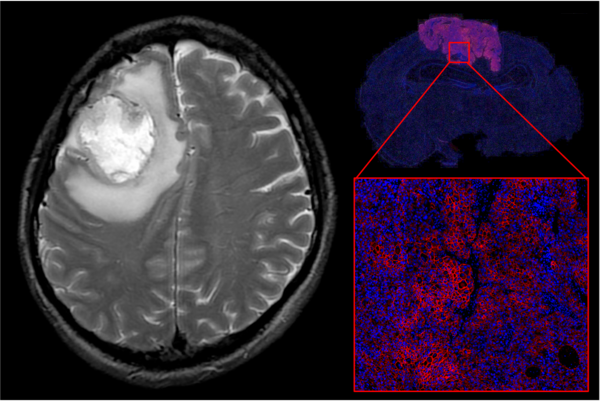
Immunotherapy has provided curative outcomes in some cancers such as melanoma but has largely failed in patients suffering from glioblastoma, the most common and deadly primary brain tumor in adults. Poor therapeutic response may be mediated in part by the abnormal tumor microenvironment. In addition to well-studied chemical and biological atypia (e.g., leaky vasculature, hypoxia), the tumor microenvironment also harbors aberrant mechanical features. Like other solid tumors, glioblastoma exerts forces both within and outside the tumor. These abnormal mechanical forces compress tumor blood vessels, promote invasion, and even compromise neurological function and perfusion in the surrounding brain. The glioblastoma microenvironment is known to be immunosuppressive, e.g., by excluding tumor-fighting immune cells and/or rendering them dysfunctional. However, the role of mechanics on immune cells – and vice versa – is largely unknown.
The TIME Lab seeks to answer these questions by studying “immunomechanics and mechano-immunology” – burgeoning subfields of cancer research at the interface of tumor biology, mechanobiology, and cancer immunology. We utilize state-of-the-art basic, mechanistic, and translational research techniques at multiple scales (in silico, in vitro, ex vivo, in vivo) including:
- Clinically relevant animal, organotypic, and engineered tissue/tumor models
- Intravital imaging (e.g., multiphoton microscopy through transparent windows in mice)
- Integrated single-cell multi-omics (e.g., RNA and spatial sequencing)
- Multi-scale platforms to explore tissue mechanics (e.g., compressive transwells and window)
- High throughput biophysical assays and drug screening platforms (e.g., on organoids)
- Science in space to benefit cancer research and patients on Earth (e.g., on the ISS)
Lead by Prof. Meenal Datta, our research efforts are aimed at understanding and targeting novel biophysical interactions in the glioblastoma microenvironment to improve immunotherapeutic outcomes.
